


There are different stages of prostatitis.They differ from each other in clinical symptoms and course characteristics.The most effective treatment is the initial stage of development of prostate inflammation.At this stage, the disease does not have time to greatly affect the functioning of the genitourinary system.The later a man with prostatitis seeks help from a doctor, the lower his chances of complete recovery.
What is prostatitis
Prostatitis is an inflammatory process that occurs in the prostate.More than half of the elderly male population is personally familiar with this disease.Doctors identify several forms of the disease, each presenting itself in its own way.During the diagnosis, urologists specify the type of prostatitis observed in the patient.The inflammation can be bacterial or non-bacterial.Both pathologies negatively affect the functioning of the gland and neighboring organs.
The pathological process has 2 patterns of development:
- Spicy ;
- Chronic.
The first symptoms of acute prostatitis appear in the first days of the disease.Their severity increases if a man does not try to cope with inflammation.The chronic course is characterized by the absence of obvious symptoms of malaise.Therefore, this form of prostatitis is usually detected during a routine examination by a urologist.

Acute prostatitis, even at the initial stage, gives bright symptoms, while chronic prostatitis does not manifest itself for long.
Chronic disease stages
Chronic prostatitis is divided into several stages, which follow one another if the man does not try to fight the disease.It can remain latent for several years.At the same time, the pathology periodically worsens.Remission and relapse of the disease gradually replace each other.
It only depends on the patient's actions, how long he will treat the disease, to what stage it can reach and whether he can fully recover.
Step 1
The initial stage of the prostate is considered the safest for health.This is why doctors recommend starting treatment at this stage.But the difficulty is that at the very beginning the disease does not cause much discomfort.A man does not always even know that he is ill.If, for a number of reasons, the patient is not able to overcome the pathological process in the prostate, it will move on to a more severe stage.And this will happen until the infectious agent is stopped by treatment.
1st degree prostatitis is characterized by the following symptoms, which will be mild:
- Body temperature rises to 38 degrees.After a while, it can increase up to 40 degrees;
- Severe pain is felt in the hip joints;
- Discomfort occurs during bowel movements;
- The penis becomes more flaccid;
- During urination, you may notice colorless mucus;
- Pain appears during urination;
- The urethra narrows, so you have to make efforts to empty the bladder;
- At night, frequent urges to go to the toilet begin to bother you;
- Sexual intercourse becomes less prolonged.
All these signs are a good reason to consult a specialist.They will bother a man for up to 3 years.It is during this period that the development of the first stage of the disease is usually observed.
Symptoms of prostate inflammation will appear and disappear, because at this stage the disease manifests itself in waves.It will seem to a person that the disease has subsided, but after a while it appears again.
Very often, patients do not complete the initial phase of prostate inflammation.As a result, the disease becomes chronic.It is very difficult to combat this form of pathology.Processing will take a long time and require a significant investment.However, there is no guarantee that at the end of treatment the disease will regress.
A urologist can identify the initial stage of prostatitis in a patient if he undergoes a series of diagnostic procedures.The disease is detected through the following studies:
- Palpation of the rectum;
- Collection of secretions and semen;
- General analysis of urine and blood;
- Semen analysis;
- Ultrasound of the prostate.
Analysis of the research results will allow the specialist to determine the disease and its cause.If prostatitis turns out to be contagious, the man will be offered to take antibiotics and other drugs that help restore the affected prostate tissue and normalize its performance.The non-infectious form of inflammation also requires drug treatment.This treatment will be based on immunomodulatory drugs, food supplements and rectal suppositories with anti-inflammatory effects.
If the initial stage of the disease occurs in an unaggravated form, the patient is additionally prescribed physiotherapeutic treatment accompanied by a diet.

At an early stage, prostate inflammation responds well to treatment
Step 2
2nd degree prostatitis is accompanied by a temporary weakening of symptoms.Many men perceive this condition as healing.They postpone visits to the doctor or stop paying attention to therapy.But a decrease in the inflammatory process with such a diagnosis is a bad sign.As the first stage of the disease progressed, the prostate increased in size due to the active division of its cells.As a result, scars form on the walls.Vascular ruptures lead to disruption of blood supply to the prostate.
The second stage of prostatitis is usually accompanied by the following symptoms:
- Disruption of biological rhythms;
- Nervousness;
- Pain when urinating;
- Heart failure;
- Exacerbation of radiculitis;
- Disappearance of orgasm;
- Lack of sexual desire.
At this stage of prostatitis in men, it is difficult to correctly determine the precise localization of the pain syndrome.Initially, pain is felt in the prostate.It then extends to all areas of the basin.
Patients with stage 2 prostatitis are recommended to take immunostimulating drugs and undergo physiotherapeutic procedures.To prevent the situation from getting complicated, they must avoid hypothermia, abandon bad habits and normalize their diet.

It is very important to ensure a healthy lifestyle
Step 3
The third stage of development of prostate inflammation causes the most problems.In this case, the man is diagnosed with chronic prostatitis.At this stage, a major change occurs in the prostate tissue.They start to die quickly.The scars formed during the previous stages strongly compress the bladder.This causes the development of urinary retention, which is an extremely dangerous complication.
Prostatitis at the 3rd stage of development leads to the appearance of pathological changes in the kidneys and bladder.The whole danger is that they are irreversible.At this stage, men often complain of sciatica.
The last stage of the disease has the following symptoms:
- Frequent urge to urinate;
- Severe pain during urination;
- Low urinary pressure;
- Cut in region of kidneys;
- Lack of feeling of completely emptying the bladder after going to the toilet.
The last stage of chronic prostatitis is considered the most dangerous.At this stage, dying cells are replaced by connective tissue.This change causes the prostate to shrink in size and the urinary tract to narrow.Due to the malfunction of the system, a man develops cystic formations.It also develops impotence.
Since in the later stages of the disease the symptoms are very pronounced, the patient's life becomes very complicated.Constant pain gives him no rest, day or night.Very often, for the first time, men turn to a urologist precisely because of such obvious symptoms of prostatitis.But since irreversible processes have occurred in the gland at this stage, doctors do not guarantee the elimination of the pathology, even if the patient meets all its requirements.It is difficult for them to predict how inflammation will behave at a given stage of development.
If the case is severe and antibiotics do not provide significant relief, the patient is referred for surgery to partially or completely remove the prostate.

In stage 3, the pain becomes intense and the organ changes become irreversible.
Stages of acute illness
It is through acute inflammation of the glandular organ that prostatitis begins.The situation is gradually getting worse.The prostate is affected by an infection that successfully develops there with a weakened immune system.Chronic prostatitis is observed in those who cannot cope with the acute form of the pathology.In this case, the man will not experience any particular symptoms of the disease until it is in the acute stage.
Inflammation of the prostate, caused by an infectious pathogen, manifests itself from the first days of the disease.Therefore, this form of pathology is diagnosed earlier than chronic.Acute prostatitis is characterized by slightly different stages of development.Doctors distinguish 4 degrees of the disease, which follow one another.
Catarrhal stage
At this stage, the inflammatory process in the prostate begins.It spreads into the ductal tissues of the glandular lobules.Prostate swelling occurs, which continues to progress.At this stage, the man does not have any purulent discharge which could indicate an infection of the gland.He will be bothered by other symptoms:
- Frequent urge to go to the toilet;
- Painful urge to urinate;
- General weakness of the body;
- Variable psycho-emotional state;
- Sluggish mood;
- Irritability.
Another distinctive feature of acute prostatitis in stage 1 of development is an enlarged prostate.Although this symptom is also characteristic of the chronic course of pathology.The doctor will be able to notice this characteristic when palpating the problem area.Special tests can confirm the specialist's concerns.It is essential to refer the patient to a donation of prostate secretion to study its composition.With prostatitis, an increased number of leukocytes will be detected in the fluid.The doctor will also detect pus and mucus impurities in the sample.
Treatment of the catarrhal stage of acute prostatitis involves taking a group of drugs that suppress inflammation and reduce the severity of the main symptoms of the disease.
Massage with this pathology is strictly prohibited, like many other similar physiotherapeutic procedures.
On average, treatment of the initial stage of acute inflammation of the prostate takes about 2 weeks.During this time, the patient completely gets rid of the disease.The positive result of therapy is due to the fact that it was started before the pathology had time to lead to the development of irreversible processes in the organs of the genitourinary system.
Follicular stage
With the development of this phase of prostatitis, the swelling spreads to the follicles and excretory ducts of the prostate.Its structures begin to compress neighboring tissues, causing severe suppuration.The symptoms of the disease intensify and become more pronounced and visible.In this condition, men complain of the following signs of illness:
- Body temperature rises up to 38 degrees and does not fall;
- Sluggish mood;
- The appearance of pain in the groin area;
- Spread of pain to the genitals, anal region and hip joint;
- Painful urination;
- Pain in the region of the head of the penis;
- Defecation becomes more difficult;
- Produce a minimal amount of urine.
When you palpate the problem area, you can detect an asymmetric increase in prostate tissue.When reviewing the results of a urine test, your doctor will detect excessive pus and white blood cells in the sample.
It is very important to begin urgent treatment of the follicular stage of acute prostatitis, otherwise a malignant process may develop in the structures of the glandular organ.
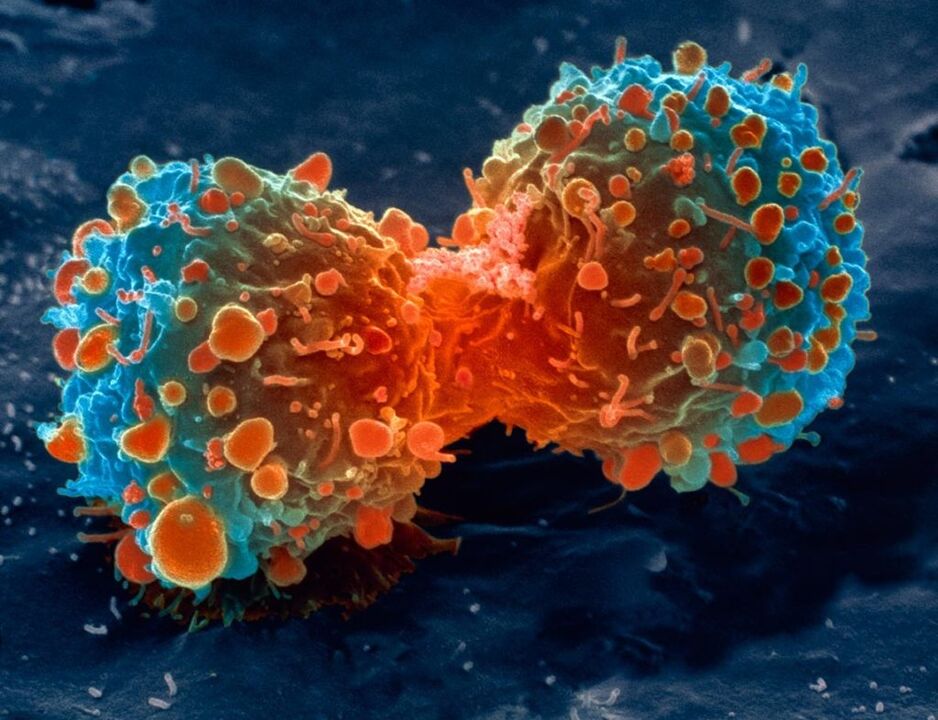
If treatment is ignored, there is a risk of developing cancer
Parenchymal stage
Prostate tissue is subject to constant damage.As a result, a large number of small pustules form there.The urinary tract is even more compressed.This results in acute urinary retention.Other symptoms of the parenchymal stage include the following conditions:
- Painful stools;
- Increase in body temperature up to 39 degrees or more;
- Constant feeling of extreme thirst;
- Loss of appetite;
- Severe weakness;
- Chronic fatigue;
- Difficulty urinating;
- Severe pain in pelvis, anus and lower back;
- Flatulence and constipation.
Abnormal mucus impurities begin to appear in the stool, as inflammation affects the intestines.The gland becomes quite large and its contours are blurred.
Abscess stage
This stage of acute prostatitis is accompanied by a number of painful signs that prevent a man from leading a full life.They are more pronounced than at the initial stage of the development of the inflammatory process.At this stage, small pustules merge into a whole formation.Purulent masses quickly accumulate there.When it gets too big, it bursts.As a result, the accumulated pus is released through the urethra.At the stage of abscess formation, the patient suffers from the following symptoms:
- Severe discomfort;
- Increase in body temperature up to 40 degrees;
- Passivity to any action;
- Severe pain in the anus and genitals;
- Difficulty defecating and urinating.
If a man in this condition does not receive adequate treatment, he may die.It is very important to eliminate the abscess so that the patient's well-being improves.Only after this will the main signs of the disease begin to subside.
Complications
The earlier treatment of prostatitis is started, the less damage the inflammatory process will cause to the body.This is why it is best to fight the disease at an early stage.But not all men adhere to this recommendation, because many hope that the disease will go away on its own.As a result, the disease progresses and leads to the development of unpleasant complications.Neglecting the help of a specialist, a person faces the following consequences of untreated prostatitis:
- The appearance of various inflammatory processes in the organs of the genitourinary system;
- Decreased sexual desire;
- Psychological disorders;
- Infertility;
- Impotence.
It is not uncommon for men who have had prostatitis not to have a normal erection.It is for this reason that the patient's sexual activity is significantly reduced.In some cases, the absence of ejaculation is considered a complication.A man's penis can suddenly fall off.If such deviations are detected, you should consult a specialist to find out the nature of the violation and find ways to get rid of them.
It should be remembered that the inflammatory process can actively spread to neighboring tissues and organs.That is why, against the background of prostatitis, men additionally develop cystitis and urethritis.These diseases lead to disruption of the flow of urine.The occurrence of chronic incontinence cannot be excluded.
Impotence is perceived by men as one of the most serious complications of acute or chronic prostatitis.With such a gap, the ability to excite disappears.This is due to inflammation that interferes with the tissue nutrition process.Edema prevents the corpora cavernosa from being completely filled with blood.Medicine has learned to treat this complication with long-term drug treatment.However, not all patients who have taken this course are satisfied with the result.
It is prostatitis that is considered the main cause of the development of 1st degree infertility.In this case, we consider a variant of the disease in which the composition of the seminal fluid changes.The secretion changes its level of acidity and viscosity.All these anomalies are detected during the examination of the semen sample submitted for analysis.
In case of infertility problem, men should contact an andrologist.It will help you choose the optimal treatment.
If prostatitis is severe, it will lead to grade 2 infertility. This condition is not amenable to therapeutic treatment.
A man's psycho-emotional mood suffers greatly from inflammation of the prostate.Frequent failures in the intimate sphere worry him.Against this background, depression appears, which further worsens the general condition of the patient.
More than 30% of patients diagnosed with prostatitis experience psycho-emotional experiences.A psychologist helps them regain male libido, reduced due to stress.

Impotence and infertility are common complications of the disease
Remission of chronic prostatitis
If treatment for prostatitis has been started, the patient may achieve remission.This is the name of a condition in which there is a significant weakening of the symptoms of the disease or their complete disappearance.Prostatitis in remission is recorded in the majority of patients who have completed the full course of treatment.This period lasts different times for each person.If a man does not follow the doctor's recommendations, after a while an exacerbation of prostate inflammation will occur.And then the patient will have to be treated again.
Species
Remission of prostatitis can be complete or incomplete.In the first case, after comprehensive treatment, the man ceases to be bothered by absolutely all symptoms of pathology.He forgets them for a long time.Incomplete remission usually lasts no more than 3 months.During this time, the patient may complain of minor symptoms characteristic of prostatitis.For example, many continue to experience painful urination and discomfort in the pelvic area.
Duration
Even experienced doctors sometimes have difficulty predicting how long remission will last for a particular person being treated for prostatitis.This indicator is individual.The duration of this period directly depends on several factors:
- The causative agent of the disease;
- General condition of the body;
- Quality of treatment;
- Severity of illness;
- Stage of the disease.
It is also taken into account the extent to which the patient conscientiously follows the recommendations of the attending physician regarding the prevention of relapses of prostatitis.
If a man fulfills all the requirements of a specialist and takes care of his own health, then his remission can last for several decades.Sometimes the disease disappears completely.
Forecast
If a patient who had to undergo treatment for chronic prostatitis begins to lead a correct lifestyle, undergoes control tests and regularly visits his doctor, and also takes medications to prevent relapse of prostate inflammation, then he will have a favorable prognosis for recovery.In this case, the illness may never bother the person again.
If a man develops prostatitis, he should immediately begin treatment.To do this, you need to contact a specialist.A comprehensive examination of the genitourinary system will help the urologist choose adequate treatment that will stop the disease and eliminate complications that may arise.